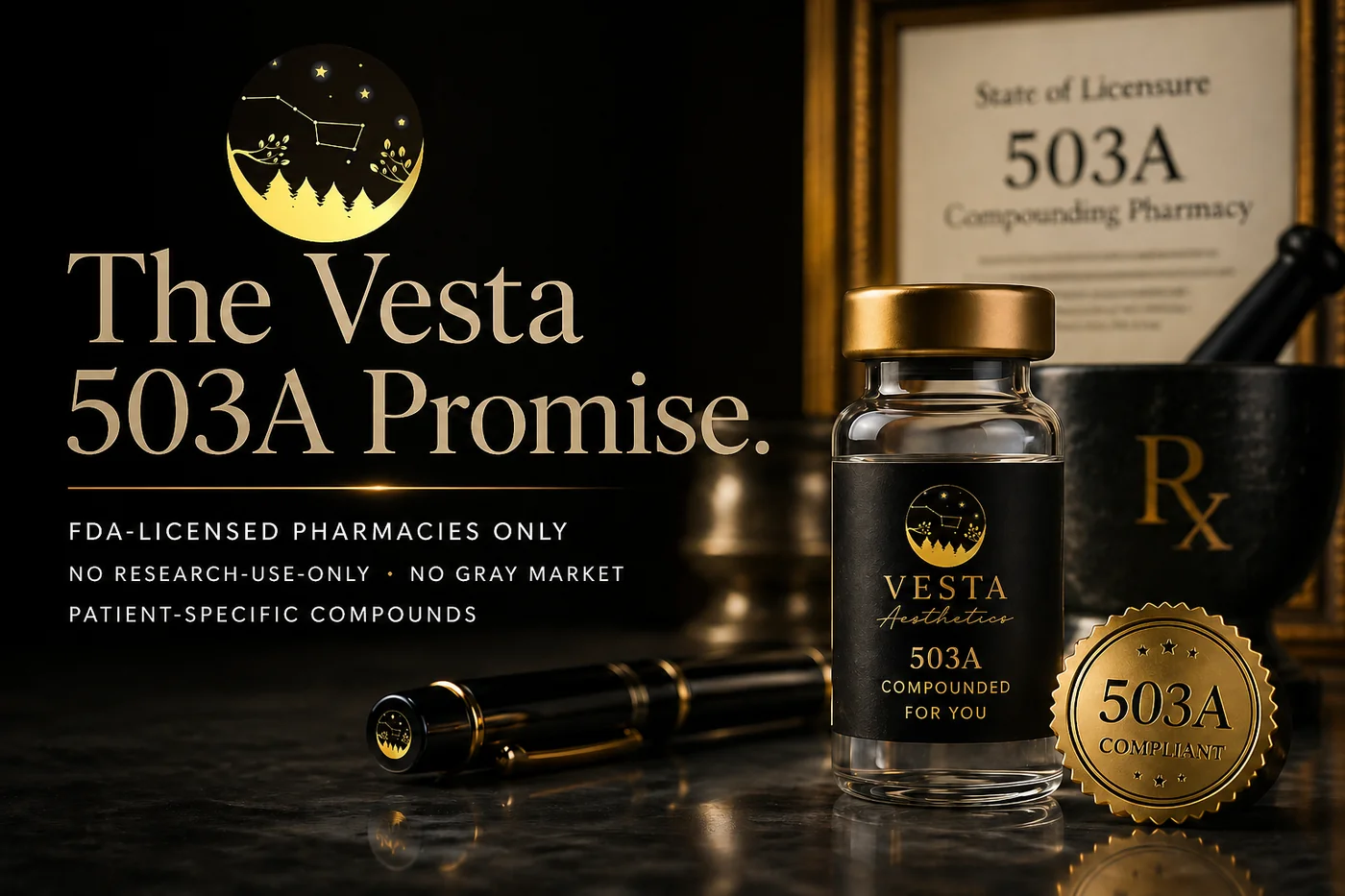
The Vesta 503A Promise, FDA-Licensed Pharmacy Sourcing
Pharmacy Sourcing Transparency · Vesta Aesthetics
Every peptide, every NAD+ vial, every hormone protocol, and every GLP-1 prescription at Vesta is filled exclusively through licensed 503A compounding pharmacies in the United States. Patient-specific. Traceable. Accountable. The full standard, in writing.
Rating
Medicine
Licensed
Treated
Certified
Sourced
503A pharmacies: what they are and why they matter
A 503A compounding pharmacy is a state-licensed, FDA-overseen pharmacy that prepares medications for an individually identified patient based on a prescription from a licensed provider. The compound is made specifically for you, your name, your prescription, your dose. 503A pharmacies are governed under Section 503A of the Federal Food, Drug, and Cosmetic Act and are subject to state pharmacy board oversight, USP <797> sterile compounding standards, and routine inspection.
This is the regulatory framework that makes legitimate peptide therapy, NAD+ therapy, hormone optimization, and GLP-1 medical weight loss possible in the United States. The same therapies sourced outside that framework, through "research use only" suppliers, gray-market e-commerce, or international labs without FDA oversight, sit in a very different category, both clinically and legally.
"Patients deserve to know the pharmacy that compounded their medication. That's not a courtesy, it's a basic standard of care."
At Vesta Aesthetics, every peptide, every NAD+ vial, every TRT, and every GLP-1 prescription is filled exclusively through licensed 503A compounding pharmacies in the U.S. This is the standard Ali holds for every patient she treats, and the basis on which she's willing to prescribe regenerative compounds at all.
Schedule a Consultation
pharmacy only
What we will and
won't prescribe.
The peptide and regenerative medicine field has a sourcing problem. Some clinics order bulk stock through "office use only" arrangements that aren't tied to specific patients. Others distribute compounds labeled "research use only", products explicitly marketed by the manufacturer as not intended for human use. A growing number of online vendors source from international labs without FDA oversight, batch testing, or traceable accountability.
Vesta doesn't operate that way. The standards below are non-negotiable for every patient and every prescription:
Here's the line we draw, and where it sits:
Schedule a ConsultationThree things 503A sourcing
actually protects.
Peptide therapy, NAD+, hormone optimization, and GLP-1 medications are well-studied and clinically valuable when sourced and prescribed correctly. The same compounds, sourced from unverified vendors, can carry meaningful risks that the marketing rarely mentions. This is what licensed pharmacy compounding is actually protecting against.
"The compound matters. The pharmacy matters. The provider matters. None of those are negotiable."
Purity & Identity
503A pharmacies test every batch for the actual presence and concentration of the compound on the label. Independent testing of "research use only" peptides has documented mislabeled product, low-purity batches, and bacterial endotoxin contamination at concentrations that would not pass any pharmacy quality assurance program. With licensed pharmacy compounding, you know what's in the vial, because the pharmacy is staking its license on it.
Sterility
Injectable medications must be sterile. 503A pharmacies follow USP <797> sterile compounding standards, with documented quality processes, environmental monitoring, and routine inspection. Gray-market vials sold for injection don't operate under any equivalent framework. Non-sterile injectables introduce real infection risk, the kind that shows up in hospital records.
Dose Accuracy
503A compounds are made to the specific concentration on the prescription, with verifiable lot-level documentation. With unverified vendors, the labeled dose may not match the actual contents. That undermines every clinical decision downstream, you can't titrate a protocol if you don't know what you're starting from, and you can't manage side effects if you don't know what's actually in the vial.
Provider accountability is real. When Ali prescribes a compounded peptide, NAD+ protocol, TRT, or GLP-1 medication, her nursing license and the pharmacy's license are both on the line. That accountability is what makes legitimate care possible, and it's why providers and pharmacies in this framework have an aligned interest in doing things correctly.
That accountability doesn't exist in gray-market sourcing. It's the difference between a regulated clinical relationship and an unregulated transaction.

You don't have to take our word for it
Every Vesta prescription is dispensed with the pharmacy name, license number, and batch information clearly labeled on the vial. Ali shares pharmacy partner details with patients on request, there's nothing proprietary about a sourcing standard. Most state pharmacy boards maintain a public lookup tool where any patient can independently verify a 503A pharmacy's licensing status and inspection history.
If you've worked with another clinic and want to ask whether your existing protocol is being filled by a licensed 503A pharmacy, that's a fair question to put to them. Real 503A pharmacies are happy to be named, their reputation depends on the quality of their work. Reluctance to disclose the pharmacy is, on its own, a sourcing signal worth paying attention to.
Talk to Ali About SourcingCommon questions about pharmacy sourcing
Honest, clinically grounded answers to the questions patients ask most often about how peptide and regenerative medicine prescriptions are sourced.
What is a 503A compounding pharmacy?
A 503A compounding pharmacy is a state-licensed, FDA-overseen pharmacy that prepares medications for an individually identified patient based on a prescription from a licensed provider. The compound is made for the patient's name, prescription, and dose. 503A is the regulatory framework that makes legitimate peptide therapy, NAD+ therapy, and hormone optimization possible in the United States.
What's the difference between 503A and 503B?
503A pharmacies compound for individual patients with a specific prescription on file. 503B "outsourcing facilities" compound in larger batches for hospital and clinic use. Both are FDA-regulated. For peptide therapy, NAD+, and hormone protocols, 503A is the standard for outpatient care, the prescription is named to the patient and tied to a specific provider order. Vesta uses licensed 503A pharmacies exclusively.
What are "research use only" peptides, and why won't Vesta prescribe them?
"Research use only" (RUO) peptides are sold by suppliers who explicitly state on the label that the compound is not intended for human use. They are not manufactured to pharmaceutical sterility or purity standards, are not subject to FDA oversight, and are not legal to sell or inject as medicine. Independent testing has documented purity, sterility, and identity issues across the RUO market. Vesta will not prescribe research-use-only peptides, regardless of the price gap.
What about "office use only" peptides?
"Office use" arrangements, where a clinic orders bulk peptide stock from a compounder without a specific patient prescription, sit outside the proper 503A framework. Compounding for an identified patient is the framework's defining feature. Vesta does not maintain bulk office stock of peptides, NAD+, or other compounded medications. Every prescription is patient-named at the time it's filled.
Are gray-market peptides illegal?
It depends on the specifics, the state, and who's doing the buying or selling. Selling research-use-only peptides as medicine for human injection is generally outside FDA rules and likely outside state pharmacy law. The legality on the patient side varies. The clinical question, whether the compound has been verified for purity, sterility, and dose accuracy, is the same regardless of how the legal questions resolve.
How do I verify my Vesta prescription is from a 503A pharmacy?
Every Vesta prescription arrives with the dispensing pharmacy's name and license number on the label, plus a batch and lot identifier. Patients can independently verify the pharmacy's licensing status through their state pharmacy board's public lookup. Ali also shares pharmacy partner information directly with any patient who asks.
Are 503A peptides "FDA approved"?
Compounded medications are not approved on a per-product basis the way mass-manufactured drugs are, that's not how compounding works. 503A pharmacies are FDA-overseen and state-licensed, and their preparations are subject to USP standards for sterility, purity, and dose accuracy. This is the same regulatory framework that produces compounded TRT, hormone preparations, and a wide range of specialty medications across U.S. medicine.
Why are 503A-sourced peptides more expensive than what I see online?
Because the cost reflects the actual standards being met. Licensed pharmacies maintain quality systems, environmental controls, batch testing, and regulatory compliance that have real costs attached. The price gap with research-use-only suppliers isn't a margin question, it's a function of what each side is actually doing. Vesta's pricing reflects the standard of care; we're transparent about that during every consultation.
Your plan starts with a $75 initial consultation
Meet one-on-one with Ali Claunch, NP-C through a HIPAA compliant telehealth consultation. We review your goals, health history, and labs, then build a personalized treatment plan. Caring for patients across Utah, Arizona, and Idaho, with in-clinic visits in Saratoga Springs.
Follow-up visits are included with an active membership. À la carte patients schedule a $75 follow-up consult at least every 90 days while on therapy. The $75 consultation fee is paid at your consultation. Start a membership within 7 days and that $75 comes straight off your first month (need more time? Just talk with Ali). After 30 days, a new consultation is needed, since labs and goals change. Full consultation policy.
Schedule a ConsultationYour complete care record,
in one place.
Access everything from your visit, organized, personalized, and always available when you need it.
Secure · Simple · Accessible anytime from any device
Access My Patient Portal →Availability updates & treatment insights
Subscribe for availability updates, announcements, and treatment insights. For Utah, Arizona & Idaho patients, unsubscribe any time.